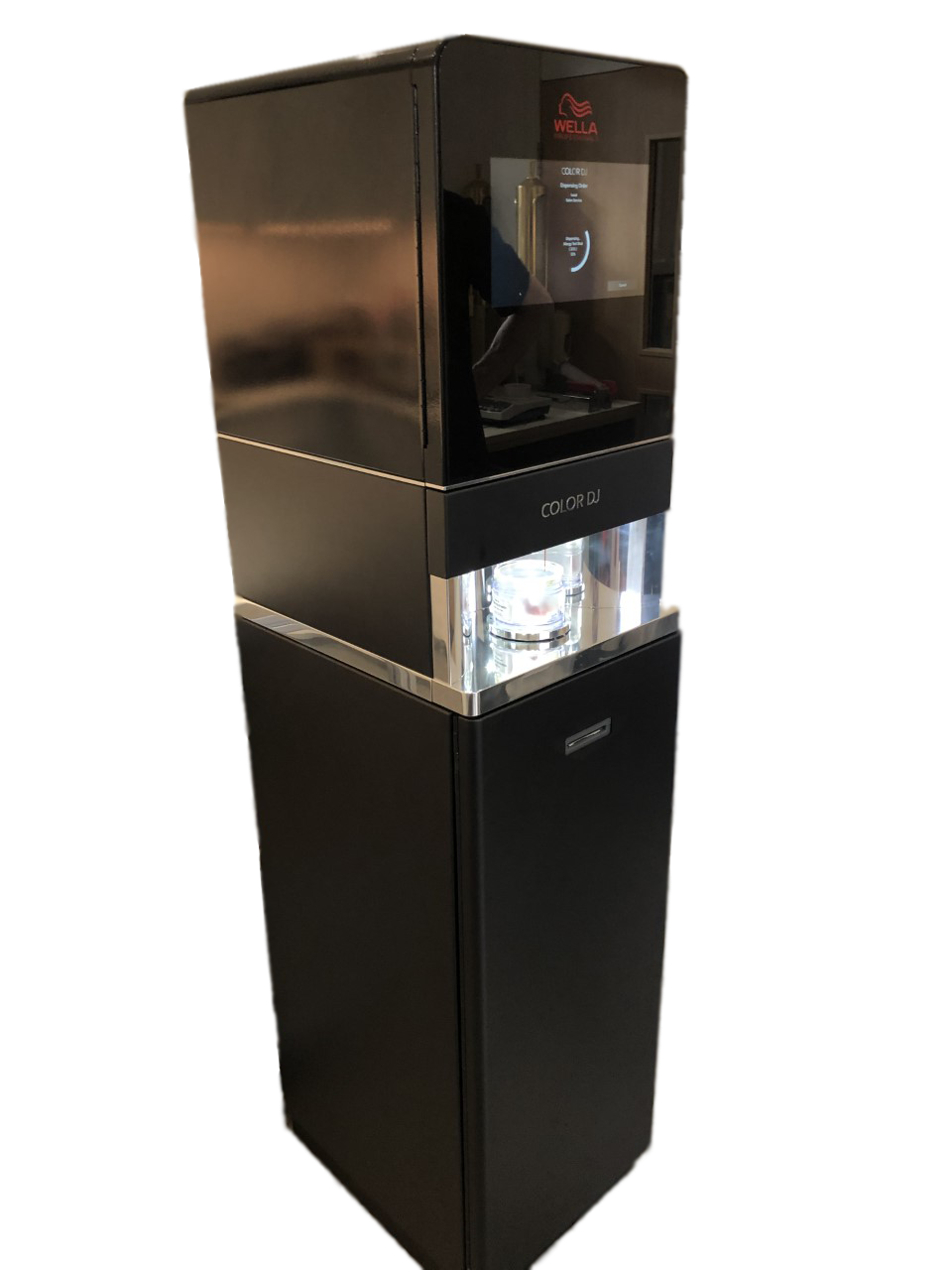
Original project photograph of the machine and its integrated touchscreen.
From a salon recipe to an automated dispense
This freestanding salon system combined a tablet-based colour formulation workflow with an embedded dispensing machine. Instead of a three-channel RGB model, recipes used seven colour ingredients: red, magenta, yellow, violet, orange, green and a white/base component. A stylist could name and save a formulation, add one of three perfume options and select from four care ingredients, then choose an in-salon or take-home dispense.
A separate web development team built the ordering progressive web application and CMS. I helped design the shared MySQL database and fully developed the machine's Qt/C++ interface and backend. I also created a Windows application for programming the ingredient-pack RFID tags at the factory.
Embedded controls and the order lifecycle
The machine used a Debian-based Linux single-board computer with a 1920 × 1080 touchscreen, an industrial 4G router and an ATmega2560 hardware controller. The Qt/XML application retrieved the order queue for that salon from the database. After an operator selected an order, a load cell detected the mixing container and the machine began dispensing.
In-salon orders used a mixing tub, while take-home orders used a jar and a printed label workflow. On successful completion the application marked the database record as dispensed, removing it from the active queue. Operators could select or delete orders, review their history and reprint labels.
- A load-cell calibration page displayed live sensor output.
- A test-shot mode dispensed five grams of each ingredient for the salon's allergy patch-test workflow.
- Maintenance controls could prime or purge individual bays and run pump suck-back operations.
- A passcode-protected engineering area provided detailed controls and indicators for 28 motors, 56 LEDs, 29 switches and the printer.
- An integrated serial monitor displayed controller communication and allowed custom commands to be sent during engineering work.
RFID consumables and inventory
Ingredients were supplied as pouches inside keyed boxes, with an RFID tag on each box. The mechanical keying restricted each box to its compatible bay. The tags carried pack information including remaining percentage, expiry date, first-use date and manufacturer details, so a pack could move between machines without losing its recorded state.
The software supported expiry-based disabling and a database-linked activation check when a pack was inserted or the machine started. The connected workflow also allowed individual packs to be disabled remotely for a recall. Central administrators could inspect pack levels across machines and use that information for replenishment planning, including just-in-time delivery. The wider administration workflow included the ability to revoke ingredients before they reached a salon.
Factory RFID programming tool
To support manufacturing, I developed a Windows Qt/C++ and XML application connected to an RFID reader and another ATmega2560 controller. An operator entered the data for an ingredient pack once, then passed multiple tags over the reader to write a batch. The form gave immediate feedback showing whether each write had succeeded. The operator could then change the pack details and start the next ingredient batch.
Dynamic label generation
For take-home formulations, I integrated a label printer using gLabels and CUPS. I created front and back label templates, took their XML representation into the Qt application and replaced the appropriate fields after a dispense. Labels included the selected ingredients, INCI ingredient names, manufacturer information and relevant stylist, customer and salon details.
System-pipe commands passed the completed templates to the Linux printing tools and printed both labels. This connected the digital recipe to the physical product without requiring staff to re-enter the formulation data.
Media, connectivity and service tools
The CMS could publish new images and videos for the machine's optional screensaver. The embedded application detected new media through database records and downloaded it with Wget through system pipes. Operators could choose individual files, play videos, images or a mixture, disable the screensaver, view its disk usage and clear downloaded files.
The 4G router connected to the embedded computer over Ethernet and provided a Wi-Fi hotspot for the tablet. An allowlist restricted the tablet's network access to the required service. Database connections used TLS.
- A device-information page showed salon and machine identifiers, network details, software and firmware versions, and the tablet's hotspot connection information.
- Time settings supported NTP when internet access was available, time-zone selection and manual date/time entry saved to the controller's real-time clock.
- An embedded Chromium browser provided a fallback ordering interface if a tablet could not be connected.