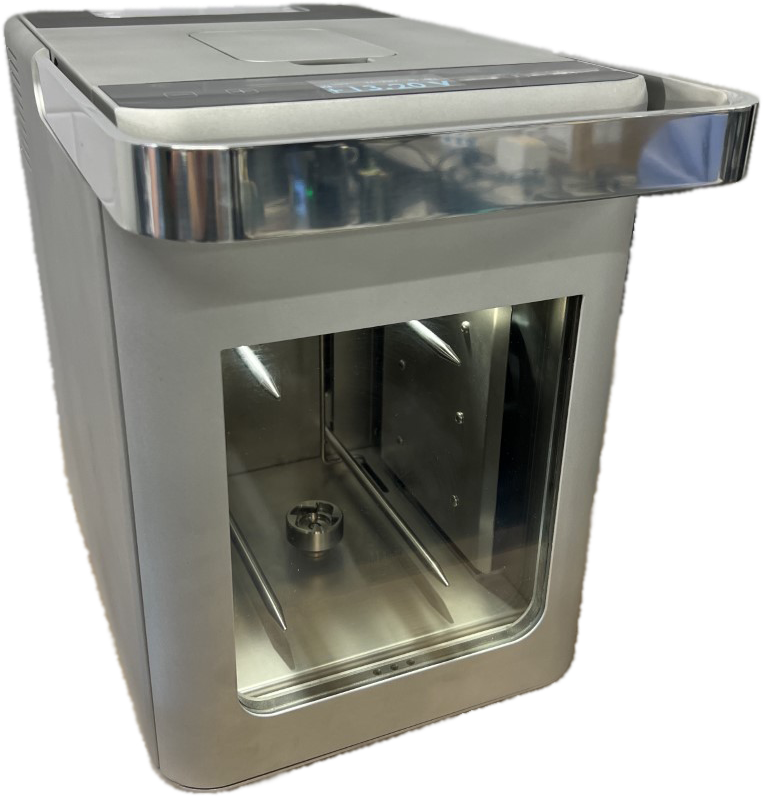
Privacy-edited interface image based on the original control screenshot; the device name has been removed.
From the project
Recording a physical process as a reusable profile
This automated bread-making project used a 1920 × 1080 touchscreen to bring mixing, dosing and baking controls into one interface. An operator could name a profile, adjust settings while the machine ran and save the sequence. Running that profile again replayed the recorded process, rather than relying on staff to repeat each action manually.
I developed the Qt/C++ and XML application on a Debian-based Linux single-board computer, its communication with the hardware controller, and the connected database and web reporting application.
The time-sensitive profiling system
The main software challenge was recording actions with enough information to reproduce their sequence. I developed a bespoke encoding system that captured the function activated, the value associated with it and its activation time relative to the start of the profile. A heater action, for example, needed its temperature value as well as when it occurred.
The resulting profile was stored in INI files on a panel-mounted USB stick. This allowed a bake to be replayed automatically and the settings to be transferred to another machine. The profile was therefore a timed record of the operator's actions, not just a static collection of final settings.
Machine controls
The interface exposed the individual process controls needed during recording and playback:
- Water dosing with millilitre control, including cold water and 25°C, 30°C or 35°C temperature selections.
- Mixer speed in RPM, mixing duration and backspin control, with a removable mixer attachment.
- A motor-driven dispenser for fruit and other extra ingredients.
- Temperature and duration settings for four 500 W heaters, with feedback from four thermocouples.
- Humidity percentage and mist or steam control.
- Motorised vent opening and closing, ventilation-fan start/stop and oven lighting.
- Celsius and Fahrenheit display/control options for different operating regions.
Separating the interface from the hardware controller
A bespoke bidirectional serial protocol connected the Linux application to an ATmega2560 microcontroller handling the hardware, drivers and safety-critical functions. The touchscreen application sent operating commands and received feedback from that controller. This separation allowed the interface and profile workflow to operate alongside the controller responsible for the physical machine.
The hardware included the water reservoir, pump and temperature sensing, mixer and ingredient-dispenser motors, heating elements, thermocouples, ventilation components and lighting. The application presented these as a coordinated process while retaining individual controls.
Shared profiles and web reporting
An internal industrial 4G router with an international machine-to-machine data plan connected the system to a MySQL-backed service. Profiling data was available through a bespoke PHP, JavaScript, HTML and CSS website on an Ubuntu dedicated server. Users could review the process and send baking settings to another system.
The implementation used HTTPS/TLS for the website, certificate-protected database connections and TLS for APIs. Together, USB export and the connected service provided two ways to move a recorded process between machines.